

Description
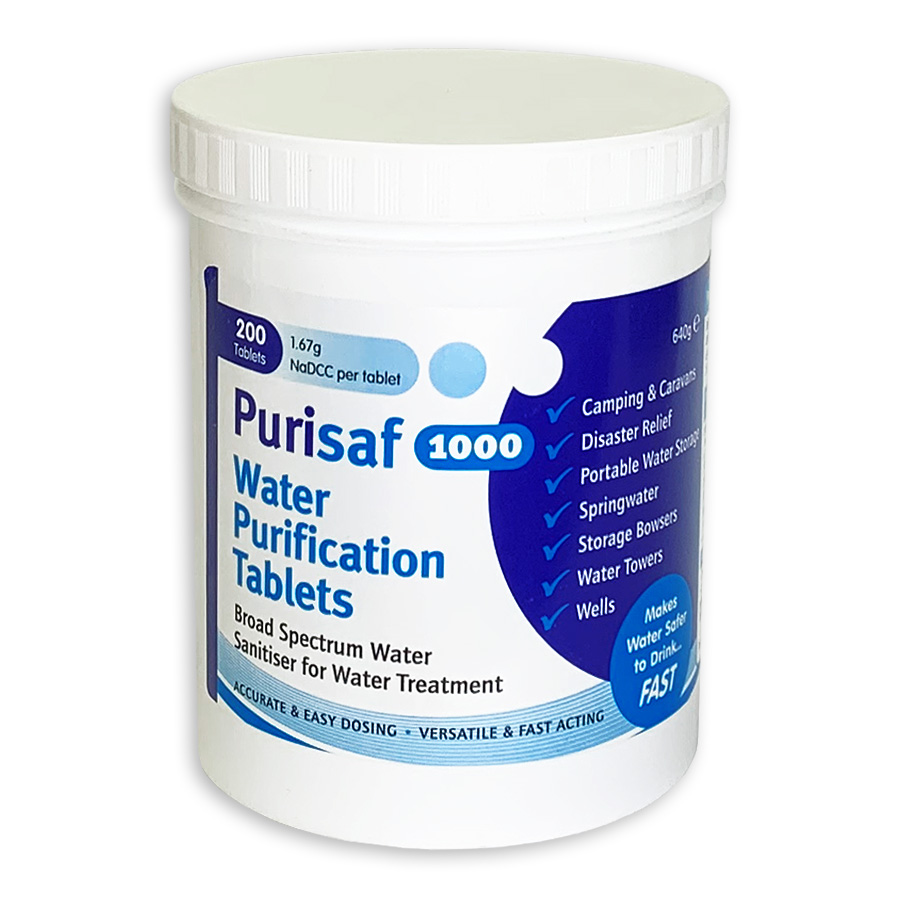
Purisaf Water Purification Tablets
Purisaf Water Purification Tablets 1000 are equivalent to more expensive brands, such as Aquatabs and Oasis 1000.
Guidelines for using Purisaf Tablets for Water Purification:
Dilutions:
- 1 tablet in 1,000 Litres = 1 ppm* available chlorine
- 1 tablet in 500 Litres = 2 ppm available chlorine
- 1 tablet in 250 Litres = 4 ppm available chlorine
- 1 tablet in 100 Litres = 10 ppm available chlorine
*ppm refers to parts per million
Depending on the level of bacterial and faecal contamination, a wide range of dosing strengths may be required. As a general guide:
- Low Risk areas require 2 ppm or (2 mg/L) and generally 10 minutes contact time minimum
- Medium Risk areas require 4-5 ppm or (4-5mg/L) and 10 minutes contact time minimum
- High Risk areas require 10-20 ppm (10-20mg/L) with extended contact times of up to 20 minutes
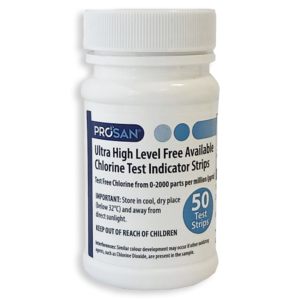
It is important to test the water after treatment, especially as the risk increases. This can be done with simple test strips which measure in 0, 1, 3, 5 and 10ppm bands using a colour coded reagent test.
Treatment of Well Water (new or contaminated):
- Make up 25 tablets in 25 Litre solution.
- Pour half into the well, operate pump until Chlorine is detected.
- Stop pumping and add remainder of solution to well.
- Leave for minimum of one hour.
- Pump again, ensuring all domestic taps are open.
- Check for Chlorine smell at each tap, then turn off.
- Wait 12 hours before checking for a minimum strength of 2 ppm.
- Refill the system with potable water.
For treating Spring Boxes or Silt Traps:
- Make up 25 tablets in 25 Litre solution.
- Using half the solution thoroughly scrub inside walls with the Chlorine solution paying particular attention to the highest and lowest water line levels.
- Pour remaining half of the solution into the Box/Trap.
- If there is a pump, repeat steps 4 to 8 (see Well Water Instruction above).
- Chlorine odour can linger and this may take a few days to disappear.
When using Purisaf Tablets in Domestic Plumbing:
- Turn off the mains water supply into the header tank to prevent it re-filling during chlorination.
- Dose the water in the tank to a minimum 50 ppm of chlorine.
- Test the header tank water using high level chlorine indicator test strips.
- Run each water tap or outlet (including WCs) until the smell of chlorine can be detected, whilst ensuring that the header tank does not empty during this time.
- When all outlets have been run and checked, top the header tank back up to the normal level and redoes to 50 ppm.
- Leave the system for at least one hour.
- Then check for residual chlorine at each tap or outlet using the test strips used previously. If the residual chlorine in the system drops to the 25 ppm level, then repeat the chlorination process.
- When the chlorination has been satisfactorily completed, the chlorine in the system can be reduced using sodium thiosulphate (not supplied) or in a small system, new fresh water introduced and the system flushed.
Important Note: Always test for residual Chlorine smell or Chlorine reading before drinking. If no residual Chlorine smell, retreat. Ground water will invariably be cleaner than surface water.
Water Source Conditions to be aware of:
- Faecal contamination is VERY DANGEROUS – avoid if suspected.
- Industrial pollution – avoid if suspected.
- Foul smelling water – possible algae contamination. Filter if possible
- Turbidty – if Turbidity measures NTU 5 or above then water must be filtered.
Technical Information:
Technical: Contains Sodium dichloroisocyanurate (sometimes referred to as Troclosene sodium, Abbrev- NaDCC).
Formula: Cl2N3O3Na
Synonyms: Sodium Dichloro -1,3,5 – Triazinetrione Anhydrous. Sodium Dichloro – S – Triazine -2,4,6 1H,3H,5H)-Trione. Troclosene Sodium.
CAS: 2893-78-9
EC/EINECS No.: 220-767-7
Chemical Name: 1,3,5 – Triazine -2,4,6 (1H,3H,5H) Trione 1,3, – Dichloro, Sodium Salt
Chemical Family: Chlorinated S Triazine Trione
Export Tariff: 3808 942090
NOTE: All of the above information is offered without any implied warranty or indemnity. The user should satisfy themselves that the product is being used in accordance with local guidelines and instructions.